Body chemistry / FULL LESSON
How Atoms Build Your Body | Matter, Elements & Ions
Connect atoms and elements to the body, then distinguish changes in protons, neutrons, and electrons.
Read the companion guide & try the questions ↓GO BEYOND THE VIDEO
Learning companion
The chemistry of a living body begins with a counting rule: proton number identifies an element. Changes in electrons or neutrons answer different questions and should not be confused with a change of element.
Original study notes by Anatomy in Minutes · Updated October 14, 2026
Ask what changed
A carbon atom has six protons. Changing its neutron count makes a different isotope of carbon. Changing its electron count changes its electric charge. As long as the nucleus still has six protons, the element is carbon.
A neutral atom has equal numbers of protons and electrons. Losing electrons leaves a positive ion; gaining electrons creates a negative ion. Ordinary chemical reactions rearrange electrons and bonds rather than turning one element’s nucleus into another.
Connect particles to body functions
Atoms occur in many arrangements: water molecules, large proteins, membrane lipids, and dissolved ions. Sodium and potassium ions help establish electrical conditions across cell membranes. Iron is incorporated into hemoglobin, while calcium contributes to skeletal mineral and also participates in signaling.
The approximate statement that oxygen, carbon, hydrogen, and nitrogen make up about 96 percent of body mass is a mass comparison. It does not say that other elements are unimportant, or that those four elements are present mainly as separate gases.
Use an organizer that shows reasoning
For a three-minute independent review, make three columns in your journal: particle changed, property affected, element preserved? Add rows for a proton, neutron, and electron change. Write one body example beneath the table. Explain your choices with counts rather than copying a periodic-table picture.
Key concepts
- Atomic number
- The number of protons in a nucleus; it identifies the element.
- Isotope
- An atom with the same proton count but a different neutron count from another atom of that element.
- Ion
- An atom or group of atoms with a net electric charge.
Check your understanding
Take 3–5 minutes independently. Write an explanation in your own words or sketch a labelled model on paper before opening each answer. These are original practice prompts; nothing is submitted or graded.
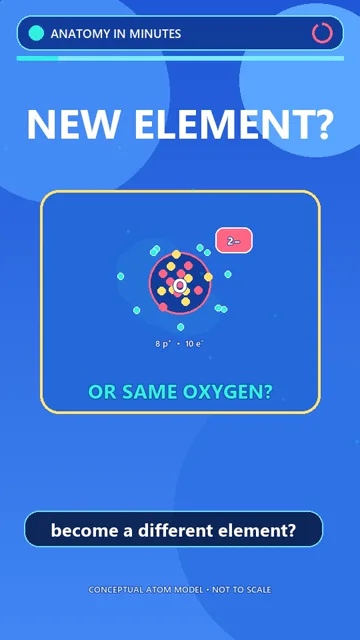
An atom has eight protons and ten electrons. What can you conclude?
Show reasoning
It is oxygen with a net charge of minus two. The extra electrons alter charge, while eight protons preserve oxygen’s identity.
Why does a small mass percentage not imply a small biological role?
Show reasoning
Amount and function measure different things. A small quantity of an element can be essential within a protein or signaling process.
Sources and further reading
Use these references to check the science and explore the topic in more detail. The notes above are an original learning companion, not a transcript or copied textbook passage.
Illustrations and AI-assisted scenes simplify scale, timing and anatomy. They are educational representations, not clinical recordings or evidence about an individual. This page provides general education, not diagnosis or treatment.
Suggest a correction or ask a content question