Body chemistry / QUICK SHORT
What Your Body Is Really Made Of
Zoom from the body to tissues, cells, molecules, and the elements that make them.
Read the companion guide & try the questions ↓GO BEYOND THE VIDEO
Learning companion
Zooming into the body reveals levels of organization, from organs and tissues to cells and chemicals. The point of the short is that biological structures are organized arrangements of matter, not separate from chemistry.
Original study notes by Anatomy in Minutes · Updated October 14, 2026
Keep the levels connected
An organ such as the heart contains multiple tissue types. Those tissues include specialized cells and surrounding material. Within cells, molecules form structures and participate in reactions. Molecules themselves contain atoms joined in particular arrangements.
A change in scale also changes the question you ask. At organ level, you might ask how the heart pumps. At cell level, you could ask how a muscle cell contracts. At chemical level, you might examine the proteins and energy-transfer reactions that support contraction. These explanations connect rather than compete.
Read the four-element claim carefully
Oxygen, carbon, hydrogen, and nitrogen together account for about 96 percent of human body mass in a commonly used approximate composition model. “By mass” is essential: this is not the percentage of body parts, the percentage of atom types, or a ranking of biological importance.
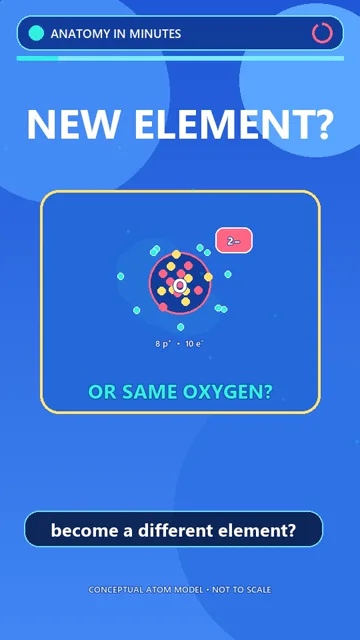
Oxygen’s large share includes oxygen atoms in water and other compounds, not just oxygen gas in the lungs. Elements present in smaller quantities still matter. For example, iron contributes to hemoglobin, and calcium supports both skeletal structure and cell signaling.
Create a scale ladder
For two minutes, draw a five-rung ladder labeled organ, tissue, cell, molecule, and atom. Choose the heart as your starting organ and add one example or question at each rung. Use arrows to show that the lower levels contribute to the structure and function above them.
Key concepts
- Element
- A type of atom identified by its number of protons.
- Molecule
- A group of atoms joined by chemical bonds.
- Mass percentage
- A component’s mass expressed as a proportion of the total mass.
Check your understanding
Take 3–5 minutes independently. Write an explanation in your own words or sketch a labelled model on paper before opening each answer. These are original practice prompts; nothing is submitted or graded.
Does “about 96 percent” mean the body has only four elements?
Show reasoning
No. It describes the combined mass share of four abundant elements. Other elements make up the remainder.
Why is oxygen in water relevant to the body-composition claim?
Show reasoning
The count includes oxygen atoms regardless of the compounds containing them. It is not limited to oxygen gas.
Can a heart’s function be explained using chemistry without ignoring anatomy?
Show reasoning
Yes. Chemical processes within cells support tissue behavior, and the organ’s arrangement organizes that behavior into pumping.
Sources and further reading
Use these references to check the science and explore the topic in more detail. The notes above are an original learning companion, not a transcript or copied textbook passage.
Illustrations and AI-assisted scenes simplify scale, timing and anatomy. They are educational representations, not clinical recordings or evidence about an individual. This page provides general education, not diagnosis or treatment.
Suggest a correction or ask a content question