Circulation / QUICK SHORT
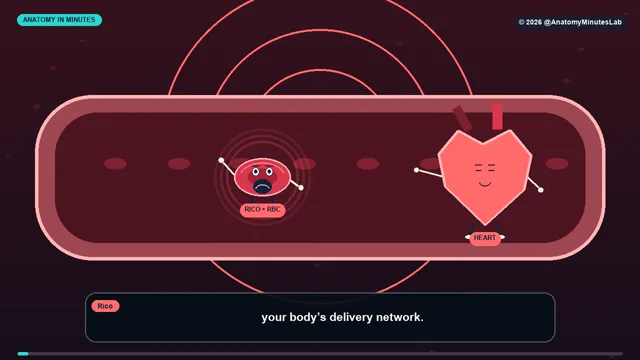
How Blood Circulates in 47 Seconds
Trace the heart–lung–body circuit in a brief red-blood-cell journey.
Read the companion guide & try the questions ↓GO BEYOND THE VIDEO
Learning companion
Use this short as a route check. The useful memory aid is directional: arteries carry blood away from the heart, and veins carry it toward the heart. Oxygen level is a separate property.
Original study notes by Anatomy in Minutes · Updated October 14, 2026
Test the rule at the lungs
Pulmonary arteries leave the right side of the heart carrying relatively low-oxygen blood. Pulmonary veins return oxygen-rich blood from the lungs to the left side. Both names fit the direction rule even though their oxygen content reverses the familiar pattern in many body vessels.
The short compresses a complete circuit. Blood goes from the right heart to the lungs, then through the left heart to body tissues, and finally back to the right heart. The heart’s two sides belong at different points along that route.
Read a diagram without relying on color
Red and blue are common diagram codes for relative oxygen content. They do not mean that blood is actually blue, or that every artery must be drawn red. Human blood remains shades of red as hemoglobin’s oxygen loading changes.
For two minutes, sketch the circuit using only pencil and arrows. Label one artery and one vein beside the lungs. Add O2 beside the site where oxygen enters blood. A successful drawing makes the route understandable even without colored pencils.
Key concepts
- Artery
- A vessel carrying blood away from the heart.
- Vein
- A vessel returning blood toward the heart.
- Pulmonary
- Related to the lungs; pulmonary vessels connect the heart and lungs.
Check your understanding
Take 3–5 minutes independently. Write an explanation in your own words or sketch a labelled model on paper before opening each answer. These are original practice prompts; nothing is submitted or graded.
Can you identify a vessel as an artery from blue coloring alone?
Show reasoning
No. Read the arrows and its connection to the heart. Diagram color represents oxygen content only if the key says so.
A route reads right heart → lungs → body. What important stop is missing?
Show reasoning
The left heart. Blood returns from the lungs before the left ventricle pumps it into the systemic circuit.
Why does the same red blood cell pass through both circuits?
Show reasoning
The circuits connect in series. Lung exchange loads oxygen for transport, and tissue exchange allows that oxygen to reach body cells before blood returns.
Sources and further reading
Use these references to check the science and explore the topic in more detail. The notes above are an original learning companion, not a transcript or copied textbook passage.
Illustrations and AI-assisted scenes simplify scale, timing and anatomy. They are educational representations, not clinical recordings or evidence about an individual. This page provides general education, not diagnosis or treatment.
Suggest a correction or ask a content question