Breathing / QUICK SHORT
Where Oxygen Enters Your Blood
A compact view of the alveoli, respiratory membrane, and oxygen's route to hemoglobin.
Read the companion guide & try the questions ↓GO BEYOND THE VIDEO
Learning companion
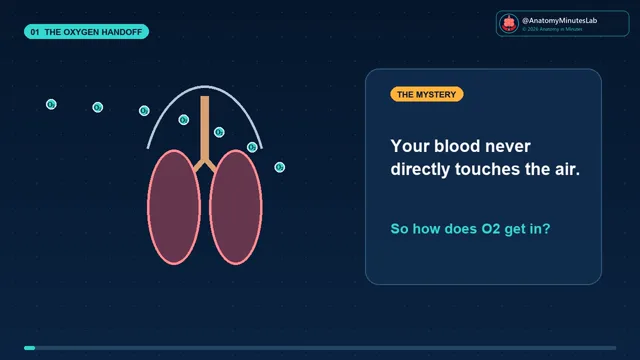
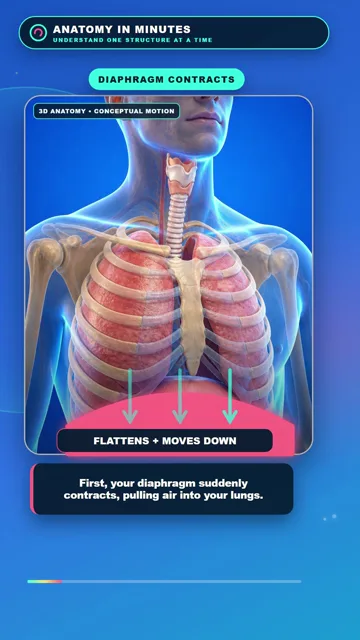
The short gives you a location and two arrows: oxygen moves from alveolar air into blood, and carbon dioxide moves from blood into alveolar air. The next step is explaining what those arrows cross.
Original study notes by Anatomy in Minutes · Updated October 14, 2026
Keep air space, membrane, and blood separate
Picture an alveolus beside a capillary. Between them is a thin respiratory membrane. The air space is not an opening directly into the blood vessel. Oxygen crosses the barrier as molecules, enters the blood, and can bind to hemoglobin inside red blood cells.
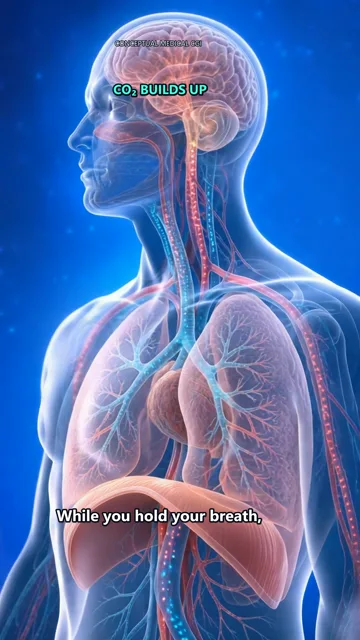
Carbon dioxide takes the reverse route across the barrier before it leaves with exhaled air. Its direction does not mean that oxygen and carbon dioxide must swap as paired molecules; each gas responds to its own partial-pressure gradient.
Turn a quick animation into a clear sketch
Spend two minutes drawing two neighboring spaces in your journal. Label one alveolar air and the other capillary blood. Put a narrow boundary between them and draw one arrow for each gas. Add a red blood cell entirely inside the capillary.
Now write a caption explaining the boundary’s importance. Mention both separation and exchange. A helpful model shows why the gases can cross quickly while preserving the difference between an air sac and a blood vessel. Enlarged molecules and arrows are teaching symbols, not their real size or motion.
Key concepts
- Alveolus
- One small lung air sac; alveoli is the plural.
- Respiratory membrane
- The thin barrier separating alveolar air from capillary blood.
- Partial-pressure gradient
- A difference in a gas’s partial pressure that drives its net diffusion.
Check your understanding
Take 3–5 minutes independently. Write an explanation in your own words or sketch a labelled model on paper before opening each answer. These are original practice prompts; nothing is submitted or graded.
Why should the red blood cell stay on the blood side of your drawing?
Show reasoning
The cell carries oxygen within the circulation. Oxygen crosses the exchange barrier, while the red blood cell normally remains inside the capillary.
What would be wrong with labeling both gas arrows “into blood”?
Show reasoning
At the lungs, the usual net directions differ: oxygen enters blood, while carbon dioxide leaves blood for alveolar air.
Is a large air sac automatically a better exchange surface than many tiny sacs?
Show reasoning
No. Many small sacs together provide a large total surface area. Exchange also depends on barrier thickness, gas gradients, ventilation, and blood flow.
Sources and further reading
Use these references to check the science and explore the topic in more detail. The notes above are an original learning companion, not a transcript or copied textbook passage.
Illustrations and AI-assisted scenes simplify scale, timing and anatomy. They are educational representations, not clinical recordings or evidence about an individual. This page provides general education, not diagnosis or treatment.
Suggest a correction or ask a content question