Kidneys & homeostasis / FULL LESSON
How Your Kidneys Save Water When You're Dehydrated
Follow the kidney's water-conservation response and see why urine becomes more concentrated.
Read the companion guide & try the questions ↓GO BEYOND THE VIDEO
Learning companion
The kidneys conserve water by reclaiming more of the water that has already entered their tubules. The central relationship in this lesson is between a hormone signal, adjustable water channels, and the concentration gradient around a collecting duct.
Original study notes by Anatomy in Minutes · Updated October 14, 2026
Follow the signal to the membrane
When water loss raises plasma osmolality, osmosensitive regions help stimulate vasopressin release. A substantial fall in effective circulating volume can also promote this response. Vasopressin, or antidiuretic hormone (ADH), is made in the hypothalamus and released from the posterior pituitary.
In collecting-duct principal cells, the signal increases aquaporin-2 channels in the membrane facing the tubular fluid. More channels make that membrane more permeable to water. ADH is a signal; aquaporin-2 is a channel. Neither manufactures water.
A doorway needs a driving difference
The kidney medulla contains an osmotic gradient supported by salt transport and urea recycling. Water moves out of collecting-duct fluid by osmosis when a suitable pathway is available. It then returns toward the circulation. The gradient and permeability must work together.
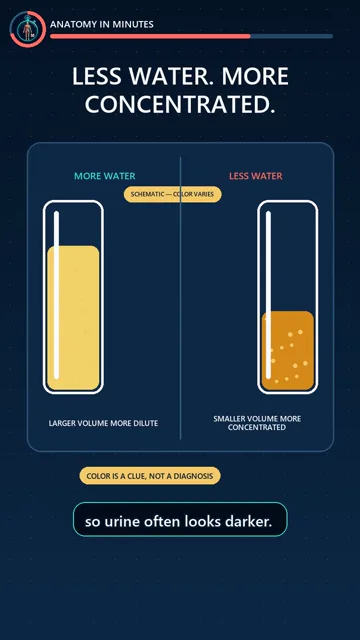
Most filtered water has already been recovered upstream. This final adjustment can leave less water in the urine and increase its concentration. Water conservation is therefore a change in how filtered material is handled, not a complete shutdown of waste removal.
Key concepts
- Reabsorption
- Movement of filtered material from the kidney tubule back toward the blood.
- Osmolality
- The concentration of dissolved particles per kilogram of water.
- Aquaporin-2
- A regulated water channel inserted into the urine-facing membrane of collecting-duct cells.
Check your understanding
Take 3–5 minutes independently. Write an explanation in your own words or sketch a labelled model on paper before opening each answer. These are original practice prompts; nothing is submitted or graded.
If more channels appear but there is no useful osmotic gradient, is that enough to reclaim extra water?
Show reasoning
No. A permeable pathway alone does not supply the directional driving force for net water movement.
Why is “the kidneys make water when you need it” an incorrect summary?
Show reasoning
The response recovers water already present in filtered fluid. It changes how much is lost, rather than creating a new supply.
Draw three linked boxes labeled signal, channel, and gradient. What belongs in each?
Show reasoning
Vasopressin is the signal; aquaporin-2 provides the adjustable channel; the medullary osmotic gradient favors water movement toward the surrounding tissue and circulation.
Sources and further reading
Use these references to check the science and explore the topic in more detail. The notes above are an original learning companion, not a transcript or copied textbook passage.
Illustrations and AI-assisted scenes simplify scale, timing and anatomy. They are educational representations, not clinical recordings or evidence about an individual. This page provides general education, not diagnosis or treatment.
Suggest a correction or ask a content question