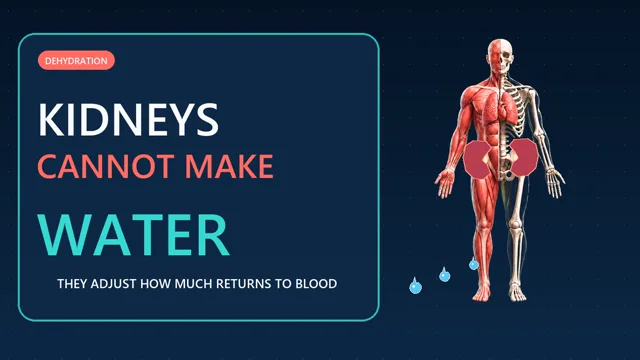
Kidneys & homeostasis / QUICK SHORT
Why Your Urine Gets Darker When You're Dehydrated
See how conserving water changes urine concentration, and why color is a clue rather than a diagnosis.
Read the companion guide & try the questions ↓GO BEYOND THE VIDEO
Learning companion
Darker yellow urine can accompany water conservation, but color alone cannot tell you exactly how hydrated someone is. This short is most useful when you follow the mechanism and also identify the limits of the visible clue.
Original study notes by Anatomy in Minutes · Updated October 14, 2026
Explain concentration before interpreting color
When the kidneys return more filtered water toward the blood, less water remains to carry dissolved wastes and pigments out in urine. Normal yellow pigments can therefore become more concentrated. A smaller volume and a darker appearance can accompany the same underlying water-conservation response.
Vasopressin helps collecting-duct cells insert aquaporin-2 water channels into their urine-facing membranes. Water movement still depends on the osmotic gradient around the duct. The hormone changes the route available to water; it does not produce a new pigment or create water.
A clue needs context
Foods, vitamins, medicines, and other pigments can alter urine color. Sample timing also matters. Therefore, an observation such as “this sample is darker” is weaker than the conclusion “this proves dehydration.” The latter claim requires information beyond appearance.
Try this reasoning exercise on paper: compare two imagined cups containing the same amount of yellow dye but different amounts of water. Predict which looks darker. Then explain why real urine is more complicated: the amount and type of colored material are not held constant. No actual samples are needed.
Key concepts
- Concentration
- The amount of a substance relative to the amount of fluid containing it.
- Collecting duct
- A kidney passage where hormone-regulated water recovery helps adjust final urine concentration.
- Evidence limitation
- A reason an observation cannot establish a particular conclusion by itself.
Check your understanding
Take 3–5 minutes independently. Write an explanation in your own words or sketch a labelled model on paper before opening each answer. These are original practice prompts; nothing is submitted or graded.
If the amount of pigment stays the same while water decreases, what happens to concentration?
Show reasoning
It increases: the pigment is distributed through less water. This can deepen the color without adding pigment.
Why is “dark urine always means dehydration” too strong?
Show reasoning
Several factors can change color, including foods and medicines. The same visible result may have different explanations.
Does the bladder cause this water-conservation adjustment?
Show reasoning
No. The kidney tubules and collecting ducts adjust urine formation. The bladder mainly stores the urine that arrives.
Sources and further reading
Use these references to check the science and explore the topic in more detail. The notes above are an original learning companion, not a transcript or copied textbook passage.
Illustrations and AI-assisted scenes simplify scale, timing and anatomy. They are educational representations, not clinical recordings or evidence about an individual. This page provides general education, not diagnosis or treatment.
Suggest a correction or ask a content question