Brain & nerves / QUICK SHORT
Why Can Normal Light Hurt During a Migraine? | Anatomy Case 02
A short anatomy drama connects an ordinary lamp with migraine-related light sensitivity.
Read the companion guide & try the questions ↓GO BEYOND THE VIDEO
Learning companion
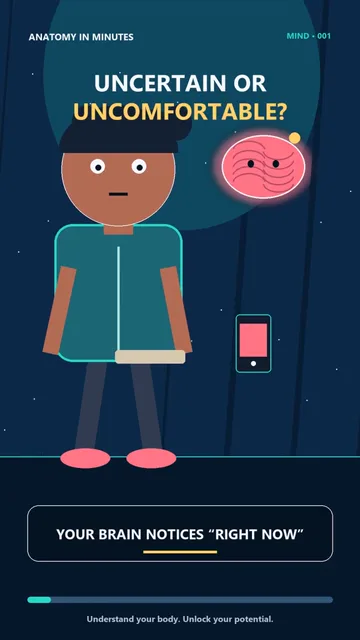
How can the same lamp feel comfortable at one time and painful at another? This fictional case separates an external stimulus from the nervous system's response to it.
Original study notes by Anatomy in Minutes · Updated October 14, 2026
Light is an input; discomfort is an experience
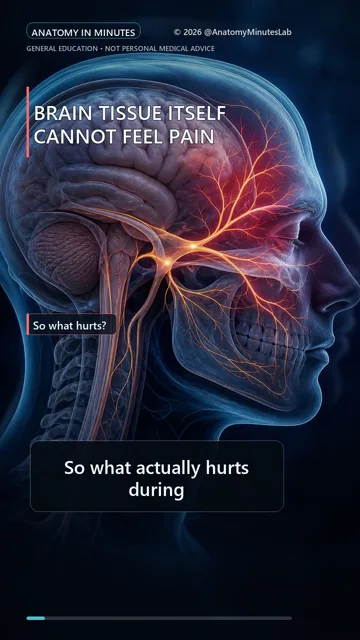
Light reaching the retina is converted into nerve signals. During a migraine attack, light can intensify discomfort even when the room's brightness has not changed. This sensitivity is called photophobia; in this context the word describes discomfort from light rather than necessarily a psychological fear of it.
Research links this effect to interactions between pathways carrying light information and pathways involved in migraine pain, including connections in the thalamus. That is a useful explanation of a network interaction, not evidence that all migraine symptoms come from one switch or one brain region.
Read the case as a model
The characters and conversation are a teaching scenario, not a real patient's examination. Separate three statements: the lamp is on; the character reports pain; the narration proposes a biological explanation. Only the first two are observations within the story. The pathway explanation draws on research beyond the story.
People can experience migraine differently, and light sensitivity also occurs in other conditions. A scene cannot diagnose a viewer or establish the cause of a new headache. Sudden severe headache or headache with new weakness, confusion or loss of vision needs urgent medical assessment.
Key concepts
- Retina
- Light-sensitive tissue at the back of the eye that initiates visual signals.
- Photophobia
- Abnormal sensitivity or discomfort in response to light.
- Sensory processing
- The nervous system's handling of incoming information, which can change without a change in the stimulus.
Check your understanding
Take 3–5 minutes independently. Write an explanation in your own words or sketch a labelled model on paper before opening each answer. These are original practice prompts; nothing is submitted or graded.
Why is 'the lamp got brighter' not required to explain the case?
Show reasoning
The external light can stay constant while the nervous system's response to it changes.
Does light sensitivity prove someone has migraine?
Show reasoning
No. It is compatible with migraine but is not unique to it; a symptom alone does not establish a diagnosis.
Sources and further reading
Use these references to check the science and explore the topic in more detail. The notes above are an original learning companion, not a transcript or copied textbook passage.
- NIH News in Health: How light boosts migraine pain ↗
- NIH: Migraine ↗
- Noseda and colleagues: Light and migraine pathways (primary study) ↗
Illustrations and AI-assisted scenes simplify scale, timing and anatomy. They are educational representations, not clinical recordings or evidence about an individual. This page provides general education, not diagnosis or treatment.
Suggest a correction or ask a content question