Brain & nerves / QUICK SHORT
Why Nervous Hands Shake
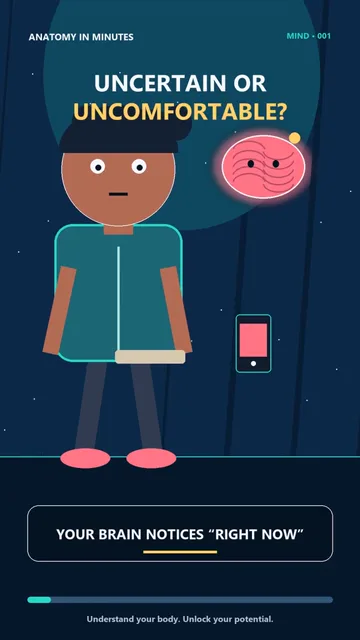
A brief story connects nervous anticipation, muscle activation, and shaky hands.
Read the companion guide & try the questions ↓GO BEYOND THE VIDEO
Learning companion
A hand held still is not completely motionless. Nervous anticipation can make a normally small tremor easier to notice, but a visible shake alone does not identify its cause.
Original study notes by Anatomy in Minutes · Updated October 14, 2026
Posture requires continuing muscle activity
Holding a hand in position requires ongoing activation and adjustment of muscles. Small oscillations are a normal feature of this system; they are called physiological tremor. They are often too slight to attract attention.
Stress or anxiety can make this tremor more noticeable. The sympathetic nervous system and circulating hormones also help coordinate the body's response to a perceived challenge, including changes in cardiovascular activity. A social event can be experienced as a challenge even when there is no immediate physical danger.
Avoid reading a diagnosis from a gesture
The video is a fictional example of nervous anticipation. Shaking hands can also be associated with fatigue, medicines, caffeine or neurological and other medical conditions. It would be an error to conclude that every person with a tremor is anxious, or that all anxiety must produce a tremor.
For a reasoning exercise, compare 'the character's hand moved' with 'the character must have a particular disease.' The first describes an observation; the second needs evidence the story does not provide. An unexplained, persistent or concerning tremor is a reason to seek individual medical advice, not to use a video as a diagnostic test.
Key concepts
- Physiological tremor
- The small oscillation present in normal muscle and movement control.
- Sympathetic response
- Coordinated nervous-system activity that helps the body respond to demands.
- Observation versus cause
- Seeing a movement does not by itself establish why it occurred.
Check your understanding
Take 3–5 minutes independently. Write an explanation in your own words or sketch a labelled model on paper before opening each answer. These are original practice prompts; nothing is submitted or graded.
Does anxiety have to create an entirely new movement to make hands look shaky?
Show reasoning
No. It can amplify the small physiological tremor that was already present.
Why is 'shaking means anxiety' an unreliable conclusion?
Show reasoning
Several factors can cause or amplify tremor. The visible movement does not uniquely identify anxiety.
Sources and further reading
Use these references to check the science and explore the topic in more detail. The notes above are an original learning companion, not a transcript or copied textbook passage.
- NIH MedlinePlus Magazine: Understanding tremor ↗
- OpenStax: Divisions of the autonomic nervous system ↗
Illustrations and AI-assisted scenes simplify scale, timing and anatomy. They are educational representations, not clinical recordings or evidence about an individual. This page provides general education, not diagnosis or treatment.
Suggest a correction or ask a content question