Breathing / FULL LESSON
How Oxygen Gets Into Your Blood | Alveoli Gas Exchange
Follow oxygen from the alveoli into pulmonary capillary blood and hemoglobin, with carbon dioxide moving in the other direction.
Read the companion guide & try the questions ↓GO BEYOND THE VIDEO
Learning companion
Breathing brings air to an exchange surface. This lesson follows the next step: oxygen crossing from an alveolus into capillary blood, while carbon dioxide crosses in the opposite direction.
Original study notes by Anatomy in Minutes · Updated October 14, 2026
Locate the boundary
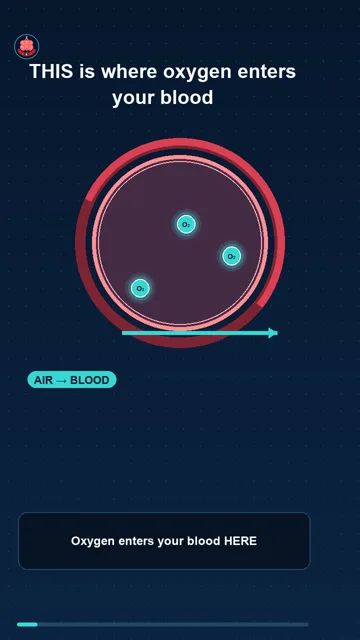
An alveolus is a small air sac surrounded by capillaries. Its air space and the blood remain separated by the respiratory membrane. Gas molecules cross this thin barrier; a red blood cell does not travel into the air sac.
Thin walls shorten the diffusion distance. The many alveoli provide a large combined surface, and their moist lining helps gases dissolve. Ventilation refreshes alveolar air while blood flow brings incoming blood and carries exchanged gases away. Both supplies matter.
Explain each arrow separately
Each gas moves according to its own partial-pressure difference. Oxygen normally has a higher partial pressure in alveolar air than in incoming pulmonary capillary blood, so net oxygen movement is into blood. Carbon dioxide has the opposite gradient and moves into the air sac.
After crossing, much of the oxygen binds to hemoglobin inside red blood cells. Transport in blood and diffusion across the membrane are connected but different steps. Exhalation then removes carbon dioxide-containing air; it does not pull individual molecules directly out of distant body cells.
Make the mechanism visible
Work independently for three minutes. Draw an air sac beside a capillary in your journal. Keep the two spaces separate, draw opposite oxygen and carbon dioxide arrows, and write one sentence explaining why a thin barrier helps. Check your arrows against the lesson before adding detail.
Key concepts
- Diffusion
- Net movement down a gradient; gases cross the respiratory membrane down their partial-pressure gradients.
- Ventilation
- Movement of air into and out of the lungs.
- Hemoglobin
- The protein in red blood cells that binds and transports much of the blood’s oxygen.
Check your understanding
Take 3–5 minutes independently. Write an explanation in your own words or sketch a labelled model on paper before opening each answer. These are original practice prompts; nothing is submitted or graded.
An illustration shows air bubbles flowing straight into a blood vessel. What should you correct?
Show reasoning
Keep the air and blood separated. Show gas molecules crossing the respiratory membrane rather than bulk air mixing with blood.
Why is increasing surface area useful?
Show reasoning
A larger exchange surface allows more gas molecules to cross at once, provided ventilation, blood supply, and the barrier support exchange.
Sources and further reading
Use these references to check the science and explore the topic in more detail. The notes above are an original learning companion, not a transcript or copied textbook passage.
Illustrations and AI-assisted scenes simplify scale, timing and anatomy. They are educational representations, not clinical recordings or evidence about an individual. This page provides general education, not diagnosis or treatment.
Suggest a correction or ask a content question