Breathing / QUICK SHORT
Why Exercise Makes You Breathe Faster
See how movement signals, working muscles, and gas exchange contribute to faster, deeper breathing.
Read the companion guide & try the questions ↓GO BEYOND THE VIDEO
Learning companion
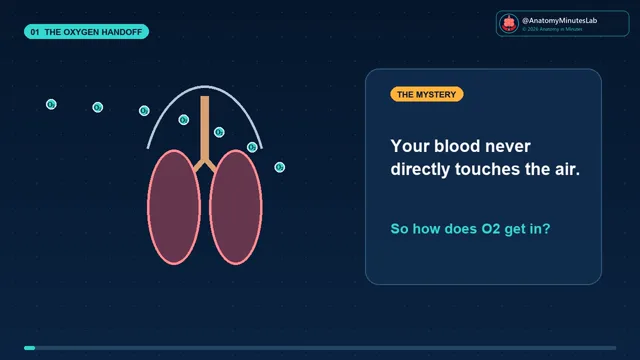
Breathing can increase as movement begins, before arterial oxygen falls. This short connects that rapid adjustment with nervous-system signals and the rising gas-exchange demands of working muscles.
Original study notes by Anatomy in Minutes · Updated October 14, 2026
Expect more than a low-oxygen alarm
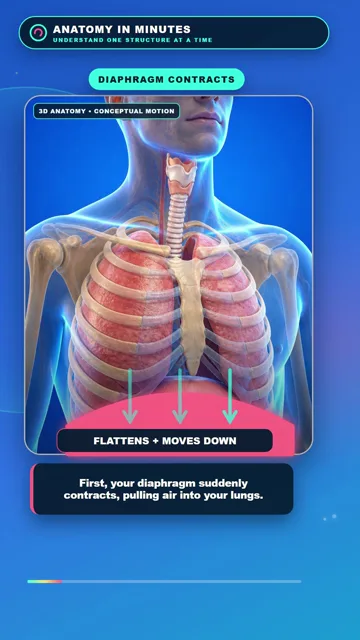
Commands involved in starting movement and feedback from active muscles help adjust the activity of breathing centers. The diaphragm and other breathing muscles change how much air moves. This coordination helps ventilation rise alongside activity rather than waiting for a large disruption.
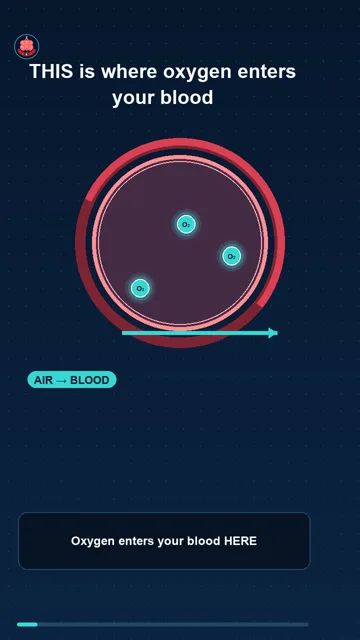
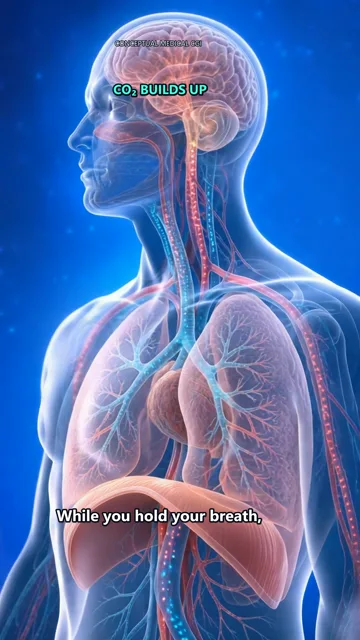
As muscles use more ATP, metabolic pathways must regenerate it more rapidly. Oxygen use and carbon dioxide production usually increase during sustained activity. Circulation carries gases between muscles and lungs while ventilation refreshes air at the exchange surface.
Distinguish rate from matching
Exercise hyperpnea is increased breathing that meets greater metabolic demand. Hyperventilation means ventilation is excessive relative to carbon dioxide production, lowering arterial carbon dioxide. A person breathing rapidly during exercise is therefore not automatically hyperventilating.
Breathing frequency alone gives an incomplete picture. The depth of each breath matters too. Minute ventilation combines breaths per minute with the volume per breath, although some air remains in conducting passages instead of reaching an exchange surface.
Explain the timing
On paper, place three labels in sequence: movement begins, breathing changes, gas transport matches demand. Beneath them, name one nervous-system contribution and one muscle-metabolism contribution. The goal is a linked explanation, not a claim that all exercise responses follow a single rigid timeline.
Key concepts
- Central command
- Signals associated with initiating movement that also help coordinate cardiovascular and breathing responses.
- Muscle feedback
- Sensory input from active muscles that contributes to regulation during exercise.
- Hyperpnea
- Increased ventilation accompanying higher metabolic demand, such as during activity.
Check your understanding
Take 3–5 minutes independently. Write an explanation in your own words or sketch a labelled model on paper before opening each answer. These are original practice prompts; nothing is submitted or graded.
Why can breathing increase before blood oxygen drops?
Show reasoning
Movement-related signals and sensory feedback can adjust breathing in advance of a large chemical disturbance.
Two people breathe equally often. Must they move the same amount of air each minute?
Show reasoning
No. One may take deeper breaths. Frequency and breath volume both affect ventilation.
What extra information is needed before calling fast breathing hyperventilation?
Show reasoning
You need to know whether ventilation exceeds the body’s carbon dioxide production and lowers arterial carbon dioxide; speed alone is insufficient.
Sources and further reading
Use these references to check the science and explore the topic in more detail. The notes above are an original learning companion, not a transcript or copied textbook passage.
- OpenStax — Exercise hyperpnea and hyperventilation ↗
- Primary human study — Muscle feedback and exercise breathing ↗
- NHLBI — How the body controls breathing ↗
Illustrations and AI-assisted scenes simplify scale, timing and anatomy. They are educational representations, not clinical recordings or evidence about an individual. This page provides general education, not diagnosis or treatment.
Suggest a correction or ask a content question