Skin & repair / QUICK SHORT
Why Bruises Change Color
Follow the breakdown and clearance of blood pigments beneath intact skin.
Read the companion guide & try the questions ↓GO BEYOND THE VIDEO
Learning companion
A bruise can reveal an injury beneath an unbroken surface. Its changing appearance reflects blood outside vessels and the body's processing of that material.
Original study notes by Anatomy in Minutes · Updated October 14, 2026
Blood is outside its usual pathway
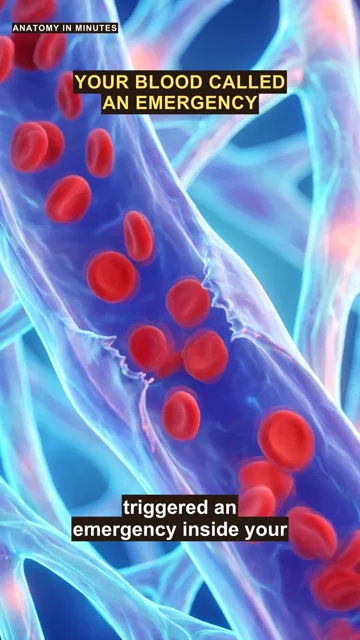
A bump can damage small vessels without cutting through the skin. Blood then enters surrounding tissue. That is different from blood travelling normally inside a vein, and different from bleeding through an open cut. Hemoglobin in red blood cells contributes to the early appearance of a bruise.
Cells break down and remove damaged material. Processing of heme, the pigment-containing part of hemoglobin, produces breakdown products including green biliverdin and yellow bilirubin. These processes contribute to color changes while the leaked material is cleared.
Color is not a reliable calendar
The colors in a teaching animation are simplified. Real appearance depends on the depth and amount of blood, lighting, skin pigmentation and several overlapping processes. Different areas of one bruise may look different at the same time. You cannot reliably assign an exact injury date from a color chart.
For a drawing, show an intact epidermis, a small injured vessel below it and a patch of leaked blood. Add a second panel showing cleanup over time, without attaching exact day numbers to colors. This models location and process while acknowledging variation; it is not a way to interpret an unexplained mark on a person.
Key concepts
- Contusion
- Another term for a bruise caused by injury to underlying tissue.
- Hemoglobin
- The oxygen-carrying protein of red blood cells, which contains heme.
- Pigment breakdown
- Chemical processing of colored molecules as damaged blood is cleared.
Check your understanding
Take 3–5 minutes independently. Write an explanation in your own words or sketch a labelled model on paper before opening each answer. These are original practice prompts; nothing is submitted or graded.
How can bleeding occur without an opening in the skin?
Show reasoning
A vessel below the surface can break while the outer skin remains intact, allowing blood to collect in tissue.
Why should a model avoid labelling every yellow bruise as a particular number of days old?
Show reasoning
Color varies with depth, skin and other factors. The same color can occur at different times, so it cannot reliably date an injury.
Sources and further reading
Use these references to check the science and explore the topic in more detail. The notes above are an original learning companion, not a transcript or copied textbook passage.
- MedlinePlus: Bruises ↗
- MedlinePlus: Bruise healing ↗
- Maguire and colleagues: Can you age bruises accurately in children? (systematic review) ↗
Illustrations and AI-assisted scenes simplify scale, timing and anatomy. They are educational representations, not clinical recordings or evidence about an individual. This page provides general education, not diagnosis or treatment.
Suggest a correction or ask a content question