Skin & repair / QUICK SHORT
Your Skin Sheds—Why Doesn't Your Tattoo?
Compare the shedding epidermis with deeper pigment-bearing tissue to explain tattoo persistence.
Read the companion guide & try the questions ↓GO BEYOND THE VIDEO
Learning companion
Surface renewal does not replace every layer of skin at once. Use depth to explain why shedding outer cells does not simply erase pigment placed farther below them.
Original study notes by Anatomy in Minutes · Updated October 14, 2026
Two layers, different structures
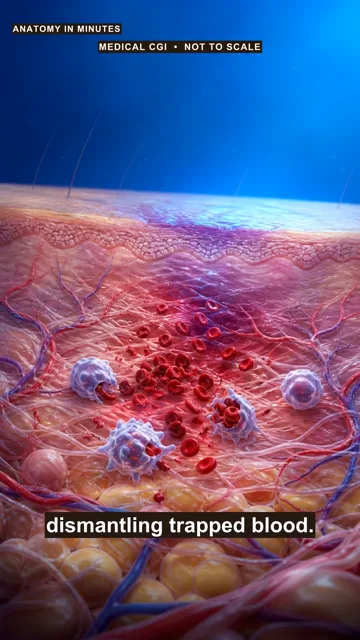
The epidermis forms the outer barrier. Its cells develop in deeper epidermal layers, move outward and are eventually shed from the surface. Beneath it, the dermis is connective tissue containing structures such as blood vessels, nerves and glands. Treating both layers as one sheet hides the key distinction.
Permanent tattoo ink is introduced into the dermis. Pigment persists within that deeper tissue, including pigment held in cells, while the epidermis renews above it. It is not simply a coating painted onto the cells that will next flake away.
Persistence does not mean no change
Tattoo appearance can change and fade. The explanation of depth does not imply that every pigment particle remains in precisely the same location forever or that skin stops responding to the material. It also does not establish that a procedure or ink is safe; tattooing has risks including infection and allergic reactions.
Use the virtual skin lab for a drawing task. Make a cross-section with a thin outer epidermis and a deeper dermis, label the shedding surface, and place a pigment marker within the dermis. Add an upward arrow for epidermal cell movement. Keep your illustration conceptual: real thickness varies across body regions, and no needle procedure is part of this activity.
Key concepts
- Epidermis
- The outer epithelial layer of the skin.
- Dermis
- Underlying connective tissue containing vessels, nerves and other structures.
- Surface turnover
- Replacement and shedding of outer cells rather than simultaneous replacement of every skin layer.
Check your understanding
Take 3–5 minutes independently. Write an explanation in your own words or sketch a labelled model on paper before opening each answer. These are original practice prompts; nothing is submitted or graded.
Why would a drawing with tattoo pigment only on the shedding surface fail to explain persistence?
Show reasoning
It places the pigment in the wrong location. Permanent tattoo pigment is introduced deeper, into the dermis.
Does 'the tattoo persists' mean 'the skin never changes'?
Show reasoning
No. The epidermis continues renewing, and pigment distribution and tattoo appearance can change over time.
Sources and further reading
Use these references to check the science and explore the topic in more detail. The notes above are an original learning companion, not a transcript or copied textbook passage.
Illustrations and AI-assisted scenes simplify scale, timing and anatomy. They are educational representations, not clinical recordings or evidence about an individual. This page provides general education, not diagnosis or treatment.
Suggest a correction or ask a content question