Skin & repair / QUICK SHORT
Why Does a Healing Cut Itch?
Explore several contributors to itching during healing, with the video's safety cautions preserved.
Read the companion guide & try the questions ↓GO BEYOND THE VIDEO
Learning companion
Itching is a sensory experience, not a direct measurement of repair. Learning how skin and nerves interact helps explain why 'itchy' does not necessarily mean 'finished healing.'
Original study notes by Anatomy in Minutes · Updated October 14, 2026
Repair involves tissue and signals
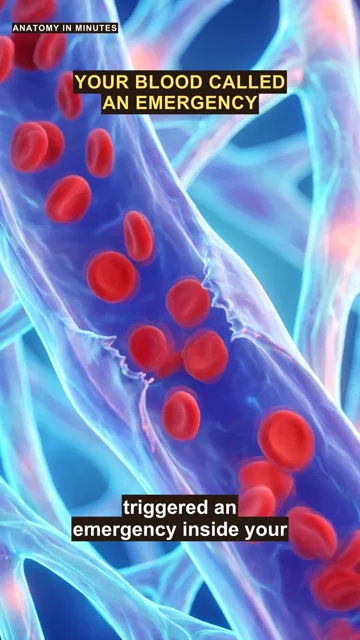
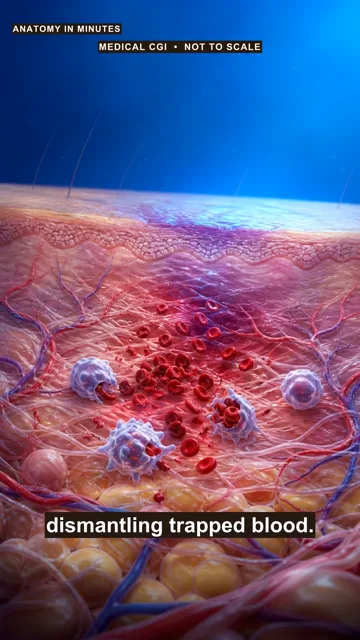
After an injury, clotting, inflammation, tissue growth and remodeling overlap. Cells communicate through chemical signals, while the skin's structure and sensory input change. Itch can accompany this process. A simple explanation that attributes every itch to new skin growing leaves out these interactions.
Histamine is one chemical that can stimulate itch, but not every itch uses the same pathway. Work on wound itch describes contributions from inflammatory mediators, sensory nerves and changes in the healing tissue. Evidence from chronic wounds or burns should not be assumed to explain every small cut in exactly the same way.
Separate a sensation from a conclusion
The statement 'the area feels itchy' reports a sensation. 'The wound has completely repaired' is a conclusion about tissue condition. The first statement cannot establish the second. Scratching can also damage a fragile surface, so this lesson does not ask you to scratch, reopen or experiment on a wound.
Use an imaginary case instead: draw a repair timeline with overlapping stages and place a question mark above where itch might occur. Explain why there is no single itch checkpoint that tells you repair is complete. Worsening redness, pain, swelling or drainage should be discussed with a health professional rather than interpreted using this model.
Key concepts
- Inflammatory mediator
- A chemical signal involved in the response to injury or irritation.
- Sensory nerve
- A nerve carrying information from tissues toward the central nervous system.
- Remodeling
- Later reorganization of repaired tissue, continuing after a surface may appear closed.
Check your understanding
Take 3–5 minutes independently. Write an explanation in your own words or sketch a labelled model on paper before opening each answer. These are original practice prompts; nothing is submitted or graded.
What is missing from the claim 'itch proves the cut is healed'?
Show reasoning
It substitutes a sensation for evidence about the condition of the tissue. Itch has several possible contributors and is not a reliable progress meter.
Why should a timeline show overlapping stages?
Show reasoning
The body's repair processes can occur together; a staged diagram is an organizing tool, not a set of identical timed steps in every wound.
Sources and further reading
Use these references to check the science and explore the topic in more detail. The notes above are an original learning companion, not a transcript or copied textbook passage.
Illustrations and AI-assisted scenes simplify scale, timing and anatomy. They are educational representations, not clinical recordings or evidence about an individual. This page provides general education, not diagnosis or treatment.
Suggest a correction or ask a content question