Skin & repair / QUICK SHORT
Your Blood Built a Bandage Before You Did
See how vessel constriction, platelets, and fibrin help a small cut stop bleeding.
Read the companion guide & try the questions ↓GO BEYOND THE VIDEO
Learning companion
Stopping a small leak requires more than one kind of response. Follow how a damaged blood vessel, platelets and clotting proteins contribute different jobs.
Original study notes by Anatomy in Minutes · Updated October 14, 2026
Slow the leak, build a plug, reinforce it
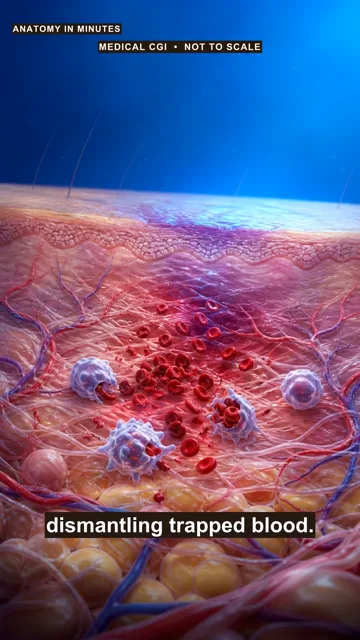
Hemostasis means limiting blood loss from a damaged vessel. Vessel constriction can reduce flow through the injured region. Platelets attach at the damage, become activated and help recruit other platelets into a plug. Platelets are small cell fragments, not miniature red blood cells.
Coagulation involves reactions among clotting proteins. These reactions lead to fibrin, a protein that forms strands and helps stabilize the platelet plug. The process is coordinated and overlapping; a short animation separates the actions so they are easier to follow.
A clot begins repair; it does not finish it
The title's 'bandage' is an analogy for an internal seal. A clot does not replace missing skin, sterilize a wound or complete tissue repair. Inflammation, new tissue formation and later remodeling continue after bleeding has slowed or stopped.
Blood vessels occur in the dermis beneath the epidermis. A cut that reaches those vessels can bleed, even when its visible opening looks narrow. Use the skin model to locate the vessel before drawing your clot. Keep the illustration within a vessel injury rather than filling every nearby vessel with clot material.
Key concepts
- Hemostasis
- Processes that limit blood loss from an injured vessel.
- Platelet plug
- An accumulation of activated platelets at a damaged surface.
- Fibrin
- A protein network that reinforces a forming clot.
Check your understanding
Take 3–5 minutes independently. Write an explanation in your own words or sketch a labelled model on paper before opening each answer. These are original practice prompts; nothing is submitted or graded.
Why is a platelet plug different from the fibrin network?
Show reasoning
The plug consists mainly of platelets; fibrin is a protein mesh that helps hold the developing clot together.
A cut has stopped bleeding. Does that mean the original tissue has been restored?
Show reasoning
No. Limiting blood loss is an early task. Tissue replacement and remodeling take longer and may result in a scar.
Sources and further reading
Use these references to check the science and explore the topic in more detail. The notes above are an original learning companion, not a transcript or copied textbook passage.
Illustrations and AI-assisted scenes simplify scale, timing and anatomy. They are educational representations, not clinical recordings or evidence about an individual. This page provides general education, not diagnosis or treatment.
Suggest a correction or ask a content question