Breathing / QUICK SHORT
What Happens When Food Goes Down the Wrong Pipe?
Follow airway protection and the cough response when food takes the wrong route.
Read the companion guide & try the questions ↓GO BEYOND THE VIDEO
Learning companion
The throat serves both breathing and swallowing. Follow how several structures coordinate to guide a swallowed bolus toward the esophagus while protecting the airway.
Original study notes by Anatomy in Minutes · Updated October 14, 2026
Protection is a coordinated sequence
The esophagus carries swallowed material toward the stomach; the trachea carries air toward the lungs. During swallowing, the larynx moves, the vocal folds close and the epiglottis helps cover the airway entrance. Breathing and swallowing are coordinated so that material can pass toward the esophagus.
The epiglottis is not a perfect trapdoor acting alone. Muscles, sensory feedback and multiple levels of closure work together. Drawing only a flap over a pipe misses the importance of timing and coordination.
Coughing is a defense, not proof of clearance
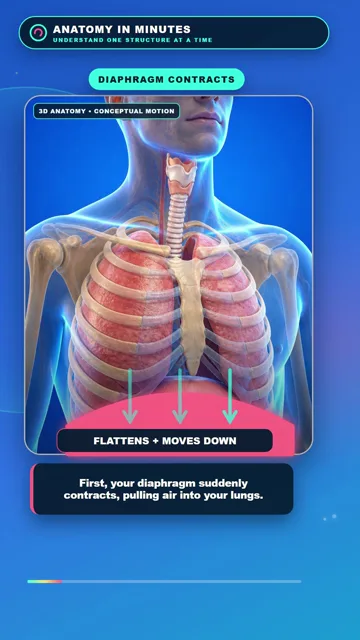
Material entering the laryngeal region can activate sensory pathways that contribute to a cough. Respiratory muscles generate pressure, and release through the opening vocal folds can produce rapid outward airflow. This can help clear irritants, but a cough does not guarantee that all material was removed.
Aspiration means material passes below the vocal folds into the airway. It can sometimes occur without an obvious cough. An airway blockage is a different, potentially life-threatening problem; someone unable to breathe or speak needs emergency help. This page explains anatomy and is not first-aid training. Never test the reflex by intentionally inhaling food or liquid.
Key concepts
- Bolus
- A prepared mouthful of material being swallowed.
- Larynx
- The voice-box region containing the vocal folds and helping protect the airway.
- Aspiration
- Passage of material below the vocal folds into the airway.
Check your understanding
Take 3–5 minutes independently. Write an explanation in your own words or sketch a labelled model on paper before opening each answer. These are original practice prompts; nothing is submitted or graded.
Draw two arrows from the throat. Which should carry air and which should carry food?
Show reasoning
Air travels toward the larynx and trachea; swallowed material is directed toward the esophagus. The paths share a region but have different destinations.
Why is 'if someone coughs, their airway must now be clear' too strong?
Show reasoning
Cough is a protective response that can move material, but it does not prove complete clearance or rule out aspiration.
Sources and further reading
Use these references to check the science and explore the topic in more detail. The notes above are an original learning companion, not a transcript or copied textbook passage.
- NIDCD: Dysphagia and the swallowing process (PDF) ↗
- OpenStax: Digestive system processes ↗
- ASHA: Adult dysphagia and silent aspiration ↗
Illustrations and AI-assisted scenes simplify scale, timing and anatomy. They are educational representations, not clinical recordings or evidence about an individual. This page provides general education, not diagnosis or treatment.
Suggest a correction or ask a content question